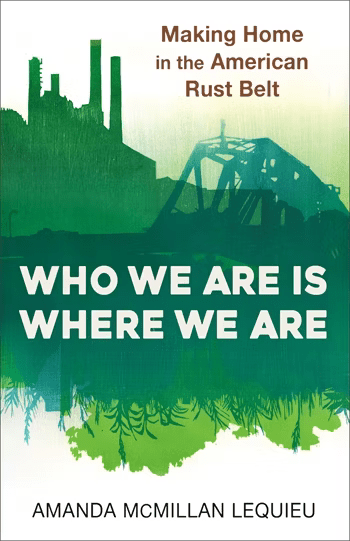
This book re-envisions the process of deindustrialization typically understood as the largely economic cause of outmigration as a surprising example of the persistence of people in place. Drawing on interviews, ethnography, and historical research from two communities in the American Midwest, this book asks not only how people remain long-term in environmentally and economically precarious landscapes, but why these places continue to matter to those who stay put.
This paper draws on unused data from the original dissertation and book project to illuminate the role of defunct industrial transportation infrastructures in residents’ contemporary assessments of economic change.I bring together theories from the sociology of culture, deindustrialization literatures, and infrastructure studies to produce a theoretically complex intervention on the role of objects and memory in meaning making.
This article asks how the term sacrifice zones has reflected and enabled changing concerns of environmentalism from 1970 to today. Through the historical genealogy of a concept deployed in academia, popular media, and activism, Dr. Anabel Ipsen and I trace how, when, and in what contexts the concept sacrifice zone has been used. We applied a Foucauldian genealogical approach to trace the interconnection of ideas and action of the keyword ‘sacrifice zones’ in newspapers, essays, and scholarly analyses. We show how every new application of the term reveals shifts in how and why power brokers consider certain human and non-human life disposable. My work on this paper was supported by a year-long fellowship at the University of Pennsylvania’s Wolf Humanities Center.
In the least densely populated neighborhood of Chicago, deindustrial brownfields are being repurposed into sites of outdoor recreation and green spaces. This paper explores the subjective experience of park development on one of these sites, focusing on how the socioeconomic contexts of the neoliberal city creates complex and ambivalent experiences of green space growth. I find that park development on the Southeast Side of Chicago produces feelings of ambivalence rather than uninhibited enthusiasm for new parks and anxiety about negative consequences. I suggest that this ambivalence about deindustrial land uses is characteristic of the neoliberalization of American communities. Given the prolonged disinvestments of deindustrialized cities, certain land use debates neither summon passionate commitment nor vehement resistance simply because they cannot address the accrual of structural social problems at hand.
This case study of coffee offers a window into the feedback loops of ecological health, agricultural economies, and social well-being on a quickly-warming planet. Drawing from a review of research across disciplines, we explore three human-driven factors that have increased the risks of loss for coffee producers in the face of climate change. These three characteristics of the coffee commodity chain—geographical consolidation, genetic variation, and market factors—enmesh social, ecological, and economic expectations of coffee as a high-value agricultural product. Considering the impact of climate change on coffee production sheds light on how climate change interacts with preexisting ecological, social, and economic challenges of global, agricultural production. This article has been widely cited, ranking in the in the top 5% of all research outputs scored by Altmetric and appearing in public-facing articles in YahooNews, Inkl, Salon, and a policy briefing by the Stockholm Environment Institute.
This paper compares two cases of contested mining proposals in the Upper Midwest region of the U.S. to examine how mining companies attempt to respond to opposition and secure regulatory approval. Combining analysis of company documents, regulatory reports, media coverage, and interviews about proposed copper-nickel mining in Minnesota and iron mining in Wisconsin, this paper assesses the discursive framing used by company elites as they seek to mitigate public concerns about environmental risks. We demonstrate how companies use environmental regulations and the scientific information needed for regulatory compliance to circumnavigate environmental conflicts.
In this article, I aim to shed light on what it means, materially and symbolically, for the rural post-industrial to be at home, with or without jobs. I define home as a center of significance, a source of negotiated stability in the face of change. Home is where material embeddedness, socially constructed identities, and familiar, embodied experiences coalesce in a meaningful manner. To understand community-wide responses to second-generation extractive industry in a place created in the image of a specific industry, we must see enthusiasm for new mining jobs within the broader, historical context of what it means for residents of certain, formerly resource-dependent regions to be at home.
Sociologists tend to view rural culture as an inertial force, committing members to past cultural patterns which, in turn, inform their present courses of action. By emphasizing such cultural stasis, we obscure how members of cultural enclaves negotiate, recommit to, or revise certain cultural traditions. Drawing on interviews I conducted among a small group of German‐heritage farmers in southern Wisconsin, I find that farmers select legal arrangements, entrepreneurial actions, and traditional male succession in order to fulfill the “yeoman” goal of keeping the farm in the family name. I argue that this dialogue between a historically persistent cultural tradition and very present pressures of agricultural production makes a significant contribution to the dynamics of modern rural life.
Book Chapters
2025 (forthcoming) Paige Kelly, Linda Labao, and Amanda McMillan Lequieu. “Rural shocks and local governance.” Invited book chapter for the decennial manual for the field of rural sociology, Rural America in the 2020s: Shocks, Stressors, and Successes, John Green and Shannon Monnant, eds. (Peer reviewed)
There is a nascent sociological imagination in us all. With or without sociological training, everyday people position their individual experiences in broader patterns. If public sociology aims to create knowledge about community-wide social problems, it is best pursued by empowering extant sociological imaginations. I suggest that sociological imaginations emerge from the highly social process of storytelling. Particularly when crises trouble previously sufficient vocabularies, offer insight into how certain groups of people are grappling with change. I call for member participation in identifying effective means of disseminating new knowledge. I demonstrate these approaches in a radio podcast project addended to my dissertation research in a rural Rust Belt community.
2019 (PDF linked here) “Power, politics and rurality.” In Routledge Companion to Rural Planning. Eds. Mark Scott, Nick Gallent and Menelaos Gkartzios (Editors). Routledge: NY. (with Michael M. Bell)
How do rural people interact with and mediate both horizontal and vertical power structures? From out-of-touch political priorities to competing regional interests, tensions between external structures and local actors can perpetuate political, economic, and legal disconnections between rural communities and their broader socioeconomic and political contexts.
2022 Essay–‘We just like it here’: Identity and community in a Wisconsin former mining town” The Sociological Review Magazine. https://doi.org/10.51428/tsr.cfks6688
2022 Podcast–“Rust Belt Stories.” Pop, the Question: Drexel University Penoni Honors College.
2020 Essay–Junior Theorist Symposium Conference preview blog, “Theorizing the Absent Object: Industrial Transportation Infrastructure Decline as Narrative Symbol in the American Rust Belt,” Perspectives (Summer 2020).Newsletter of the American Sociological Association’s Theory section.
2018 Essay–with Josh Pacewicz, Shannon Elizabeth Bell, and Colin Jerolmack. “Between Declension and Nostalgia: Bringing a Comparative Historical Gaze to the Logics and Lived Experiences of the American Rust Belt.” Trajectories (Autumn 2018) Newsletter of the American Sociological Association’s Comparative Historical Sociology section.
2018 Interview–Graduate Student Spotlight, Society for the Study of Social Problems, Community Research and Development Division, Fall 2018 Newsletter
2017 Essay and podcast–Love for Home in a Place Industry Left Behind. Radio podcast originally broadcast on WJMS AM Hurley, Wisconsin; rebroadcast on the University of Wisconsin-Madison’s Center for Culture, Nature, and Environment’s digital magazine, Edge Effects.
2014 Essay–Tastes of Home: Food and Familiarity. The University of Wisconsin-Madison’s Center for Culture, Nature, and Environment’s digital magazine, Edge Effects.
 Amanda McMillan Lequieu